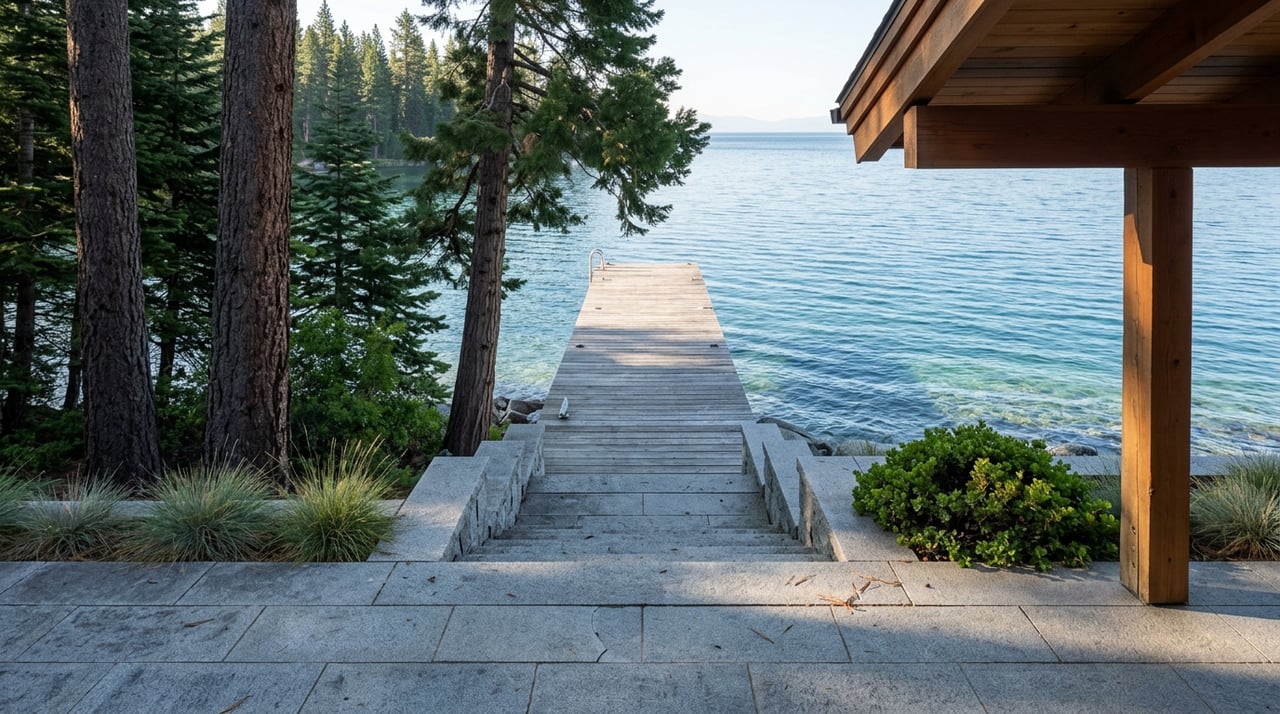
North Lake Tahoe Pier and Buoy Rights and Home Value
August 20, 2026
August 20, 2026
Drive North Lake Boulevard past Cedar Flat and Fulton Acres in Carnelian Bay and you will pass homes that look nearly interchangeable on paper. Similar square footage. Similar age. Both a short walk from the water. One is priced in the low seven figures. The other asks two or three times as much, sometimes more. The difference rarely comes down to the kitchen or the roofline. It comes down to a permit that never shows up on a spec sheet and that no amount of renovation budget can buy.
That permit governs whether the home has a pier, a buoy, or neither. And in North Lake Tahoe, that single line item is regulated more tightly than almost anything else attached to the property.
Listings use the word lakefront loosely. A private pier sits at the top of the value ladder, giving an owner exclusive deep-water access without sharing a structure or a schedule. A shared or joint-use pier sits below that, split among several parcels or an association. A buoy field ranks below both, offering a mooring but not a walk-out dock. And plenty of homes marketed as lakefront have none of the three. They have proximity, not access.
The gap between those tiers is not a design choice a builder can fix. It is set by the Tahoe Regional Planning Agency, the bi-state authority that has governed shorezone construction since the 1970s. TRPA does not treat piers and buoys as ordinary home improvements. It treats them as a finite resource with a hard ceiling.
For decades, TRPA held a blanket moratorium on new shorezone structures. In 2018, the agency's Shoreline Plan lifted that moratorium, which sounds like good news for anyone hoping to add a pier or a buoy. What it actually did was replace an outright ban with a metered allocation.
The plan authorizes up to 1,486 new private moorings across the entire lake, covering buoys, boatlifts, and boat slips combined. Piers are a separate, even smaller pool. Rather than releasing that inventory all at once, TRPA distributes it in stages, with only fifteen percent of the remaining pool in each category becoming available for permitting in any given year through a lottery. A buyer cannot simply apply and build. A parcel has to be eligible, has to hold a Best Management Practices certificate for stormwater compliance, and then has to win a slot in a queue that refills slowly by design.
That is the mechanism the median listing price never shows. When supply is capped by regulation rather than by cost, money stops being the thing that decides who gets access. Timing, eligibility, and existing permits decide it instead.
Existing moorings carry their own complications. Every buoy, boatlift, and slip with access to the lake has to be registered annually with TRPA, at a modest fee of roughly $90 per buoy and $43 per lift or slip. That fee is trivial. What is not trivial is the requirement behind it: any mooring that was never properly authorized has to be permitted retroactively or removed. TRPA can order the removal of a so-called legacy buoy at its discretion if the paperwork was never filed.
That distinction matters enormously to a buyer. A buoy bobbing offshore of a listing photo is not evidence that the buoy is legal, registered, or transferable. It is evidence that a buoy exists. Confirming its status is a due diligence step, not a formality, and it belongs in escrow rather than in a listing description.
In several North Lake Tahoe neighborhoods, the permit sits with a homeowners association rather than with an individual parcel, and that adds a second layer of scarcity on top of TRPA's own cap.
In Agate Bay, between Kings Beach and Carnelian Bay, the Agate Bay Pier and Swim Club offers a private beach, a pier, and a buoy field, with membership offered as a priority to homeowners in the subdivision. Priority is not the same as automatic inclusion. A buyer still has to confirm whether membership is currently open, whether it transfers with the sale, and whether the club has room.
In Kings Beach, Brockway Springs shows how tightly an association can bundle access. It is a gated condominium community on more than twenty acres with half a mile of private shoreline, seventy eight individually owned units, and its own shared pier and buoy field, along with the only heated pool on the North Shore fed by a natural hot spring. Buying a unit there buys into a defined, already-built system of shared access, which is exactly why those units carry a premium over comparable condos without it.
Carnelian Bay is where the pattern gets most granular. The area is made up of named subdivisions, including Agate Bay, Fulton Acres, Carnelian Heights, Cedar Flat, and Ridgewood Highlands, each recorded separately in Placer County parcel records. Some of these subdivisions run a voluntary recreational HOA that owners can opt into for pier and buoy access. Others make that membership mandatory. And because a buoy field's total capacity is capped by the size of the association's own lake frontage rather than by the number of dues-paying members, a subdivision can be full. A buyer can purchase a home inside an HOA with pier and buoy amenities and still be told there is no slot available.
Once you see the regulatory ceiling behind the word lakefront, the price spread across Kings Beach, Tahoe Vista, Carnelian Bay, and Agate Bay reads differently. A home a few blocks off the water with no mooring rights at all is priced against convenience and views. A home with a shared pier or a place in a buoy field is priced against a resource that TRPA is releasing in small, scheduled increments. A home with a private pier is priced against something the lottery may not offer again for years.
Before writing an offer on anything described as lakefront or waterfront in North Lake Tahoe, it is worth confirming a short list of specifics rather than taking the listing description at face value.
None of this shows up in a listing photo, and very little of it shows up in a standard home inspection. It shows up in the HOA resale packet, the TRPA parcel record, and the questions a buyer's representative asks before contingencies come off.
| Access tier | What it typically includes | What to verify before offering |
|---|---|---|
| Private pier | Exclusive dock, no shared schedule | Current TRPA permit, any pending repair restrictions |
| Shared or joint-use pier | Dock access split among a few parcels or an association | Usage schedule, transfer language in HOA docs |
| HOA buoy field | Mooring through association membership | Whether membership is mandatory, waitlisted, or full |
| No mooring | Proximity to the lake without a permitted dock or buoy | Whether a future permit is realistically obtainable at all |
Does a pier or buoy permit transfer automatically when a home sells? Not always. Some HOA-based memberships require a separate application from the new owner even when the physical structure stays in place. Confirm the transfer language in the resale packet rather than assuming it.
What happens if a buoy was never permitted in the first place? An unregistered or unpermitted mooring can be ordered removed by TRPA. A buyer relying on that buoy for lake access should treat it as unconfirmed until the registration is verified.
Can I just apply for a new buoy if the home I want doesn't have one? You can enter the queue, but new moorings are released through an annual lottery drawing from a capped statewide pool, with only a portion of the remaining allocation released each year. It is a process measured in years, not weeks.
The house is only ever half the purchase in North Lake Tahoe's waterfront market. The other half is a permit that a regulatory agency releases on its own schedule, and understanding which tier a specific listing actually occupies is what separates a confident offer from an expensive assumption.
If you are comparing waterfront and near-water properties across Kings Beach, Tahoe Vista, Carnelian Bay, and Agate Bay and want the access question answered before you write an offer, TruckeeTahoeHouses can walk through the permit history, HOA structure, and transfer terms behind a specific listing. Start Your Home Search when you are ready to see what a given property actually includes.
Stay up to date on the latest real estate trends.
As your trusted real estate expert, I’m here to help you navigate property transactions with ease. I focus on understanding your unique needs to ensure a smooth buying or selling experience, always striving to achieve the best results for you.